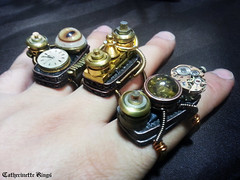
CatherinetteRings rings Steampunk with borosilicate bead
Originally uploaded by Catherinette Rings
Borosilicate glass is a type of glass with the main glass-forming constituents silica and boron oxide. Borosilicate glasses are most well known for having very low coefficient of thermal expansion (~5 × 10⁻⁶ /°C at 20°C), making them resistant to thermal shock, more so than any other common glass. Borosilicate glass was first developed by German glassmaker Otto Schott in the late 19th century and sold under the brand name "Duran" in 1893. After Corning Glass Works introduced Pyrex in 1915, it became a synonym for borosilicate glass in the English-speaking world. Kimble-Kontessee sells its own line of Kimax brand borosilicate glass products.
The European manufacturer of Pyrex, Arc International, uses borosilicate glass in its Pyrex glass kitchen products, however the U.S. manufacturer of Pyrex kitchenware uses soda-lime glass. Thus Pyrex can refer to either soda-lime glass or borosilicate glass when discussing kitchen glassware, while Pyrex, Duran and Kimax all refer to borosilicate glass when discussing laboratory glassware.
Most borosilicate glass is clear. Colored borosilicate, for the art glass trade, was first widely brought onto the market in 1986 when Paul Trautman founded Northstar Glassworks[citation needed]. There are now a number of small companies in the U.S. and abroad that manufacture and sell colored borosilicate glass for the art glass market.
In addition to the quartz, sodium carbonate, and calcium carbonate traditionally used in glassmaking, boron is used in the manufacture of borosilicate glass. Typically, the resulting glass composition is about 70% silica, 10% boron oxide, 8% sodium oxide, 8% potassium oxide, and 1% calcium oxide (lime). Though somewhat more difficult to make than traditional glass (Corning conducted a major revamp of their operations to make it), it is economical to produce because its superior durability, chemical and heat resistance finds excellent use in chemical laboratory equipment, cookware, lighting, and in certain cases, windows.
READ MORE :
http://en.wikipedia.org/wiki/Borosilicate_glass